
High-Volatility Slots in the UK: How They Play
 Available in GB
High-volatility slots can have quiet stretches and less frequent larger returns, but no spin guarantees that a win is due.

How High-Volatility Slots Shape a Session
A session on a high-volatility slot can feel uneven. There may be long stretches in which little seems to happen, followed by a win that is noticeably larger than the small returns you might see more often on a lower-volatility game. That contrast shapes the pace: quiet periods can take up much of the experience, while a single result may suddenly draw your attention back to the screen.
This is not a promise that a large win will arrive after a run of quiet spins. Each spin is not a countdown, and a slot does not owe you a result because you have waited. The pattern describes how returns tend to be distributed, not when a particular outcome will happen. A session can end without the notable win a player was hoping for.
That distinction matters because people often make sense of an uneven session by looking for a turning point. After several spins without a meaningful return, it can feel as if a better result must be close. Or, after a larger win, it can seem that the game has entered a favourable phase. Neither impression tells you what the next spin will do. The feeling of momentum belongs to the experience, not to a reliable forecast.
Why the pace can feel demanding
When small returns arrive frequently, they can make a session feel more active, even when those returns do not offset what has been staked. With high-volatility slots, fewer wins may leave more stretches where the balance moves down without much interruption. That can make time feel slower and the session more tense, especially if you are watching closely for a result that changes the picture.
A larger win, when it occurs, can stand out sharply against that quieter background. It may briefly alter how you feel about the session, but it does not erase the uncertainty that comes with continuing. A win is one outcome, not evidence that the next part will follow the same pattern. If you find yourself extending a session because a large result has made you feel that the game is now “running well”, pause and consider whether you would have made the same choice before it happened.

The reverse can be difficult too. A long quiet patch may bring disappointment or impatience, and those feelings can make it tempting to keep playing simply to see whether the pattern changes. Staying longer does not make a particular win more certain. It only gives you more time in the game, with further outcomes still uncertain.
Set the shape of the session yourself
It can help to decide what you want from the session before opening a game. You might want a short distraction, or you may be comfortable with an experience that has fewer noticeable returns. The important point is to make that choice while you are calm, rather than letting a quiet stretch or a sudden win make it for you.
A practical stopping point can be based on time, attention or an amount you have already decided you can afford to lose. Treat that boundary as part of your plan, not as a target you need to reach. If you feel yourself becoming absorbed in the thought of recovering losses or waiting for a particular result, stepping away is a reasonable response. You do not need to settle the question of whether the game is about to pay.
It is also worth noticing how you respond to gaps between wins. Some players are comfortable with an unsettled rhythm; others find it stressful and keep checking their balance or increase their stake in response to frustration. If you recognise the latter pattern, a high-volatility game may not suit the kind of session you want, regardless of how appealing a large possible win sounds. Choosing a steadier experience is a matter of preference, not a way to improve the underlying odds.
A result does not repair the whole session
The memory of a session can become dominated by its most striking moment. A larger win may make the quieter part seem less important in retrospect, while a run without one may make the entire experience feel fruitless. Neither summary changes what happened across the session. It can be useful to look at the full picture, including the time spent playing and the total amount staked, rather than judging the experience by its most exciting spin.
This is especially relevant when comparing high-volatility slots online. A game’s presentation can make its big outcomes vivid, but the session itself may be mostly made up of ordinary spins. The possibility of a standout result should not be confused with a likely finish, and the absence of one does not mean you are due a better run.
If you are looking for the best high-volatility slots, consider what “best” means for your own experience. A game that offers the kind of uneven rhythm you enjoy may still be a poor fit on a day when you need a predictable, low-pressure activity. No title can make that rhythm reliably gentle or guarantee that a quiet session will turn around.
For a more comfortable session, keep your decision to continue separate from the hope of a particular win. A high-volatility slot may produce fewer, larger returns, but the waiting between them is part of the experience, not a sign that a payout is approaching.
Top online casinos in the UK
- ChanzeBonus: Slots Welcome Bonus #1 200% up to €500 · Payout speed: 1-3 business days
- BeOnBetBonus: 100% up to €500 + 100 FS · Payout speed: 1-3 business days
- x3betBonus: Welcome Pack 100% Up to £1.000 + 200 Free Spins · Payout speed: 1-3 business days
- JetsetspinsBonus: 200% Bonus + 100 Free Spins + Free Royal Wheel · Payout speed: 1-3 business days
- WinBeastBonus: €5000 + 500 FS + €650 Freebet · Payout speed: 1-3 business days
- NightWinBonus: £900 + 400 free spins · Payout speed: 1-3 business days
- Revery PlayBonus: 100% up to€1,000+ 100 FS · Payout speed: 1-3 business days
- EvoSpinBonus: 125% up to €2500 + 125 Free Spins · Payout speed: 1-3 business days
What a Slot Machine’s Reels and Bet Structure Tell You
The reels are the most visible part of a slot, but their number does not tell you everything about how a stake is applied. A 5 reel slot game can have a bet that covers all five reels. In that arrangement, the number of reels is part of the game’s layout, while the bet control shows what your selected stake applies to.

That distinction matters when you are comparing high volatility slot machines. A game with several reels may look more complex than one with a simpler layout, but appearance alone does not tell you whether it is high volatility. Nor does the number of reels show what a particular stake covers. To understand the structure, look at the game’s own bet display and rules rather than relying on the cabinet-style image or the title.
Read the bet controls before spinning
Before you start, check what the interface identifies as your total stake and what happens when you change it. Some screens present the bet as one overall amount; others may offer controls that require you to make a selection. The important point is to understand the amount that will be committed to a game cycle, not to infer it from the number of reels on screen.
A five-reel machine can apply a bet across all five reels. So seeing a single bet figure does not mean that only one reel is covered. Equally, a row of reels does not tell you whether a displayed amount is divided into smaller parts or how the game accounts for it. Use the game’s instructions and paytable to clarify the terms shown in that particular interface.
This is useful when you move between games. Bet controls can look different, and familiar-looking reels do not guarantee that the controls work in the same way. Pause on the information screen if the displayed stake is unclear. A short check can prevent a misunderstanding about what you have selected.
- Check the total stake identified by the interface
- Understand how many reels the bet covers
- Read the game's instructions and paytable
- Verify the bet controls work as expected
Reel count is a layout detail, not a volatility label
People looking for a high volatility slot machine may be tempted to treat a larger-looking reel layout as a clue to its risk profile. That is not a dependable shortcut. Reel count describes one part of the visual and mechanical arrangement; it does not, by itself, establish the game’s volatility.
The same caution applies when someone describes a title as a very high volatility slot machine. The label should not be inferred from whether the game has a familiar row of reels, an unusual appearance or a busy screen. Those details may help you recognise the game, but they do not settle what the label means for that title.
If you are assessing slot machines with high volatility, separate the questions. First, establish the game’s basic layout and how the stake is set. Then consult the game information for any stated volatility classification. Keeping those checks distinct helps prevent a visual feature from being mistaken for an explanation of how the game behaves.
What the interface can and cannot tell you
The reels and bet panel can help you understand what you are looking at and what you have selected. They are not a substitute for reading the rules. A five-reel layout tells you that the game is presented across five reels; it does not tell you, on its own, how a particular stake is applied. The bet display and the rules together are more useful than either a quick glance at the screen or an assumption based on another game.

This is especially relevant if you are comparing what might be called the best high volatility slot machines. “Best” depends on what you want to check, and a visual resemblance is not evidence that two games share the same structure. Start with the details you can verify in each game: the reel layout, the stated stake, and the explanation of the controls. If the game describes a bet across all five reels, read that wording as applying to the full layout rather than treating each reel as a separate game.
A list of high volatility slot machines is only useful if the titles have reliable information attached to them. The reel count alone cannot confirm that a title belongs on such a list. When the classification matters to your choice, look for the game’s own information rather than relying on a general description or a familiar design.
Make the selection deliberately
Once you understand the layout and controls, choose a stake you are comfortable seeing deducted when you play. Check the amount again after changing games or adjusting the bet. A new screen can use different labels or present the controls differently, so carrying over an assumption from the previous title may lead you to select something other than you intended.
For high volatility slot machines in the UK, the same basic check applies: identify the game, read its rules, and confirm the stake shown before starting. The reels can orient you, but they cannot answer every question about the bet. Treating layout and stake as separate details gives you a clearer view of what you are selecting, without asking the reel count to say more than it can.
Do
- Use feature descriptions to understand the design
- Consult game information for volatility classification
- Verify the stated stake and layout
Don't
- Assume a busy screen means high volatility
- Rely on reel count as a volatility label
- Treat a single feature as a guarantee of returns
Game Features That Can Change the Shape of Returns
A slot’s volatility is not something you can reliably read from its appearance alone. Some features are commonly associated with low-volatility games, but they are clues about a typical design pattern, not a guarantee about how a particular title will pay. That distinction matters if you are comparing high-volatility slot games with games designed to spread returns across more frequent, smaller wins.
Low-volatility slots typically combine five reels with twenty-five or more paylines, a fixed jackpot rather than a progressive prize pool, and bonus rounds that multiply wins already accumulated. These elements describe a familiar design approach. They do not mean that every game with those features will behave identically, or that the presence of one feature settles its volatility.
Reels and paylines are part of the layout
Five reels and a substantial number of paylines are common in low-volatility games. Together, they describe how the game is arranged and which combinations can count as wins. But a larger number of paylines should not be treated as proof that a game is low volatility. Nor does a five-reel layout, by itself, tell you how large or frequent its returns will be.
That makes the feature useful as context rather than a verdict. If a game has the familiar layout, you can note that it resembles a pattern often found in lower-volatility titles. You still need to consider the overall design and the information the game provides about its play. The same caution applies when looking for a high-volatility slot game: its reel count or payline display alone cannot confirm that it offers less frequent, larger wins.
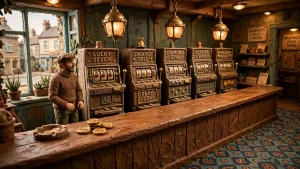
This also helps prevent a common shortcut in comparisons. A game should not be labelled low or high volatility just because its screen looks busy, has many visible lines, or uses a particular reel arrangement. Those are structural details. Volatility concerns the way returns are distributed, and the design features need to be considered in that context.
Fixed jackpots and progressive pools
A fixed jackpot is another feature typically associated with low-volatility slots. Its amount is set rather than growing as part of a progressive pool. The contrast is relevant when you are assessing the kind of prize structure a game uses, but it is not a complete measure of volatility.
The word “jackpot” can attract attention, so it is worth separating the prize label from the broader pattern of returns. A fixed amount tells you that the jackpot is not a progressive pool; it does not, on its own, establish how often the game pays other wins or how its overall returns are distributed. Likewise, seeing a progressive pool is not enough to determine every aspect of a game’s volatility.
If you are comparing several titles, treat the jackpot structure as one feature to record, not as a shortcut to a conclusion. A prize pool can be visually prominent without describing the full range of outcomes. The wider design still matters, and a single headline feature cannot stand in for the game’s complete return pattern.
Low-volatility features
Low-volatility slots typically combine five reels with twenty-five or more paylines, a fixed jackpot rather than a progressive prize pool, and bonus rounds that multiply wins already accumulated.
Bonus rounds and multipliers
Low-volatility games typically use bonus rounds in which multipliers apply to wins already accumulated. This is different from treating a multiplier as an independent prize: its effect is tied to the win it acts on. The feature can therefore shape how a bonus round presents its returns, but its presence does not automatically tell you how often the bonus occurs or what the overall outcome will be.
When you read a game description, look at what the multiplier applies to. A large multiplier may sound decisive, yet the feature is only one part of the bonus design. It does not, by itself, establish the size of an eventual return, the frequency of bonus rounds, or the volatility of the game as a whole. For a high-volatility title, do not assume that a dramatic bonus label or multiplier is enough to identify its risk pattern.
Read features as a group
The more useful approach is to consider the design as a whole. Five reels, many paylines, a fixed jackpot and multipliers on accumulated wins form a combination commonly found in low-volatility slots. None of these features should be treated as a guarantee, and no single one can classify every game.
That matters when a search for the best high-volatility slot games turns into a comparison of names and graphics. A title’s visual style does not explain its return pattern. The features above can help you recognise a common low-volatility design, but they cannot establish that a game is suitable for you or predict what a session will produce.

Use the feature descriptions to understand what the game is built around, not to promise yourself a particular result. A familiar layout or bonus mechanic may help you compare designs, but it cannot remove uncertainty from play.
What High Volatility Means in a Slot
A slot’s volatility describes the pattern of its returns: how often wins tend to occur and how large they tend to be. In a low-volatility game, returns are spread across many smaller wins. In a high-volatility game, wins tend to come less often, but may be larger when they do. The distinction is about the shape of the results, not a promise about what will happen in any particular session.
That is the simplest answer to what high volatility means in a slot. It does not mean that every win will be substantial, or that a long gap without a win must be followed by one. It describes a tendency in the game’s payout pattern. Individual results remain uncertain, so the label cannot tell you when a win will arrive or what it will be worth.
A pattern, not a prediction
It can help to think of volatility as a description of how results are distributed rather than a forecast. A high-volatility slot may produce a stretch with no return, then a win that is larger than the small payouts more common in a low-volatility game. But there is no required sequence. The game does not keep track of a player’s previous spins and owe them a win after a losing run.
This is why the term should not be read as a signal that a bigger payout is due. A win in one session does not establish that the game will pay similarly in the next, and a run of losses does not make a particular outcome more certain. Volatility can help you understand the kind of variation a game is associated with; it cannot reveal the result of the next spin.
The same distinction matters when you see phrases such as “very high volatility”. They describe a more pronounced version of the less-frequent, potentially larger-return pattern. They do not identify a threshold that guarantees a particular payout, nor do they mean the game must eventually produce a large win for you. Treat the wording as a broad description, not a personal forecast.
What volatility does not tell you
Volatility is not a measure of whether a slot is fair, and the label does not say whether you will come out ahead. It also does not, by itself, tell you the size of a possible win, how long you might play before seeing one, or how much a session will cost. Those are separate questions, and no volatility description can settle them for an individual player.
A high-volatility label also does not mean that every spin is more likely to win big. The feature concerns the overall distribution of returns: larger wins occur less often in the pattern associated with high volatility. A single spin can produce a small return, a larger one or none. The label does not change that uncertainty into a dependable sequence.

Likewise, a low-volatility label does not mean that a player will receive a return on every spin or avoid losses. It points to returns being spread across more frequent, smaller wins. That distinction can make the labels sound like opposite promises, but neither one is a guarantee of what will happen during your play.
How to read the label
If a game description identifies volatility, use it as one piece of information about the type of return pattern the game is designed to have. High volatility indicates less frequent wins that may be larger; low volatility indicates a pattern of more frequent, smaller wins. The wording is useful for setting expectations about variation, but not for choosing a moment to play or deciding that a win is likely.
Descriptions can be brief, and terminology may not be presented in exactly the same way everywhere. If you cannot find a clear volatility label, avoid inferring one from a title’s theme or appearance. A dramatic visual style is not evidence that a game has high volatility, and a simple-looking game is not proof of low volatility. The return pattern is a property of the game, not something you can reliably read from its artwork.
If you are trying to identify a high-volatility slot online in the UK, look for the game’s stated information rather than relying on its name or promotional language. A label can help you understand the intended pattern, but it does not turn an uncertain game into a predictable one. You still need to decide whether that kind of uncertainty is acceptable to you before playing.
Keep the term in perspective
The question “is high volatility good or bad?” has no universal answer within the definition itself. Volatility describes how returns tend to be distributed; it does not rate a game as safe, favourable or suitable for every player. Whether the pattern fits your circumstances is a separate decision. The label cannot tell you what you should choose, and a larger possible win does not make a less frequent return certain or compensate for a loss.
When you see “high volatility” attached to a slot, read it plainly: wins are expected less often than in a low-volatility pattern, while wins may be larger. Keep the words “tend to” in mind. They describe the game’s general character, not a guarantee for your next spin, a schedule for future wins or a promise that losses will be recovered.
High or Low Volatility: Which Suits Your Priorities?
The choice between high and low volatility is mainly about the kind of variation you are prepared to experience, not a way to make a slot more favourable. A lower-volatility game tends to return smaller amounts more often; a high-volatility slot tends to produce wins less often, with larger payouts when they do arrive. Neither pattern removes the house edge or makes a particular result dependable.
If you value a steadier series of small returns, low volatility may feel more comfortable. Across most titles, games in this category typically form winning combinations every three to six spins on average. That is a broad pattern, not a promise about what will happen in your next session: individual outcomes can differ, and a winning combination does not necessarily return as much as you staked.

High volatility may appeal if you are willing to accept longer stretches without a win in exchange for the possibility of a larger payout. That possibility is not a schedule. You cannot tell when a substantial win will occur, or assume that an uneventful run means one is due. If you find that gaps between wins make you want to increase your stake or keep playing past a limit, the high-volatility pattern may not suit you.
Match the pattern to your comfort with uncertainty
Consider how you respond when play does not go as you hoped. Frequent, modest wins can make a low-volatility game feel less uneven, but they do not mean you are ahead overall. Some returns may be smaller than the stake, and a sequence of winning combinations can still leave your balance lower. A high-volatility game can feel more demanding because wins may be less frequent and their timing is uncertain.
Your preference may also depend on what you expect from a session. If you want many small moments of return, low volatility is closer to that experience. If you are comfortable with uncertainty and do not need regular wins to stay settled, you may prefer the possibility of less frequent, larger payouts. This is a difference in the shape of possible results, not a difference in whether the game favours you.
When asking whether high or low volatility is better, it helps to separate “better for my preferences” from “better for my chances”. Neither label can tell you what you will win, how long a losing run may last, or whether a session will end in profit. A high-volatility slot is not automatically a better choice because its possible wins are larger; a low-volatility slot is not safer simply because it tends to produce more frequent combinations.
Check your expectations before choosing
A practical way to compare the two is to ask what would make play difficult for you. Would a long wait for a win tempt you to chase one? Would frequent small returns encourage you to overlook how much you have staked? If either reaction sounds familiar, the relevant issue is not finding a perfect volatility category but deciding whether to play at all and setting a firm stopping point before you begin.
It is also worth remembering that a return is not the same as a profit. A game can show a winning combination while returning less than the amount put in, and a run of small payouts does not cancel the possibility of losing. Equally, the prospect of a large payout does not make a high-volatility slot a route to better expected results.
Over enough sessions, a game that has a positive house edge is mathematically unfavourable to the player, whether its losses tend to arrive slowly or in sharper swings. The difference between volatility types is how results may be distributed along the way, not a change to that underlying expectation. This matters when a play style feels reassuring: frequent wins can soften the experience without changing the longer-run arithmetic.

There is no universal answer to whether high or low volatility is better. If you prefer more frequent, smaller returns, a lower-volatility title may better match that preference. If you can accept less frequent wins and the uncertainty around them, a higher-volatility title may feel more appealing. In either case, treat the category as a description of possible results, not a forecast or a reason to spend more.
Using Casino Bonuses Without Treating Them as a Safety Net
A bonus can look like extra room to play, but it does not remove the financial risk of real-money slots or make a session more predictable. That matters if you are considering a high-volatility casino bonus strategy: a bonus should not be treated as protection against losses or as a reason to keep playing until a particular result appears.
A specialist review reports that bonuses typically have a lifespan of 48 hours. Treat that as a deadline attached to an offer described by that review, not as a universal rule for every casino bonus. Check the operator’s own terms for the expiry time and any conditions that apply. If you cannot find those details clearly, do not assume the offer works in the way you expect.
A short expiry can create pressure to deposit or play before you have decided whether the offer suits you. You do not have to accept a bonus simply because it is available, and an approaching deadline does not improve its value. If you would not choose to play without the offer, pause rather than letting the clock make the decision for you.
- Verify the casino holds a current UKGC operating licence
- Match the company name to the public register
- Check the specific expiry terms of any bonus
- Set a firm stopping point before you begin
For a high-volatility casino bonus strategy in the UK, the practical question is not how to make a bonus last until a large win. It is whether you understand the terms and are comfortable with the possibility that the money you spend will be lost. A bonus does not change the underlying expectation of a game: over enough sessions, any game with a positive house edge has a negative mathematical expectation for the player, however gradually losses may occur.
Before accepting, read the expiry conditions and decide in advance whether you are willing to play under them. If the deadline leaves too little time for a considered choice, letting the offer expire is a valid decision. A bonus is an optional promotion, not a safety net and not a reason to hurry into gambling.
What to Check at a UK Casino Before You Play
Before depositing, check that the casino holds a current operating licence from the UK Gambling Commission (UKGC). A familiar brand name or a polished website does not establish that it is authorised to serve you.
The Commission regulates commercial gambling in Great Britain, including online casinos, and is the sole regulator for that activity there. Its oversight of remote gambling applies when a service is offered to consumers in Great Britain, even if the operator’s key equipment is located elsewhere. The UKGC grants operating licences to businesses; it also issues personal licences to individuals working in relevant roles.
Use the Commission’s public register to look up the operator and verify its licence before you deposit. Check that the company named on the casino site matches the licensed business shown in the register, rather than relying only on a logo or a claim in the site’s footer. If you are considering a high-volatility casino for its slot selection, that does not change the basic check: the operator’s licence is about who is authorised to provide the gambling service, not how a particular game behaves.

A licence check is a practical first step, not a recommendation of a casino or a guarantee about your experience. If you cannot confirm the operator’s status, pause before sharing payment details or funding an account. Taking a moment to verify the licence gives you a clearer basis for deciding whether to proceed.
The Difference Between High- and Low-Volatility Slots Over Time
The difference between high- and low-volatility slots is visible in how their returns tend to be spread out. A low-volatility game returns smaller amounts more often, while a high-volatility one tends to pay less frequently, with larger wins when they arrive. Over a short stretch, either pattern can look different from its general tendency: a low-volatility slot may have a quiet spell, and a high-volatility slot may produce a win early. Neither outcome establishes what will happen next.
Across repeated play, the contrast concerns the timing and size of returns, not whether one style removes the cost built into a game. If a slot has a positive house edge, its mathematical expectation is negative over a sufficiently long run of sessions. In other words, the average expected result favours the house, even if a player’s losses build gradually rather than appearing in a few sharp swings.
That distinction matters when you look at a sequence of results. Frequent small wins can make a session feel less uneven, but they do not turn a negative expectation into a positive one. Likewise, a less frequent large win may interrupt a run of losses without changing the underlying expectation. A striking result in one session is not evidence that the long-run balance has shifted.
Volatility describes the pattern a player may encounter, not a reliable forecast for an individual session. Considering results over time can help separate that pattern from the impression created by a recent run. It cannot make outcomes predictable or cancel the house edge. Set limits you can afford to lose, and do not treat either frequent small returns or the possibility of a larger win as a dependable way to recover money.