Slingo Sites Not on GamStop
Best Non GamStop Casino UK 2026
Loading...
The Game That Split the Difference
Slingo occupies the space between bingo and slots — and that’s exactly why it works. The format was created in 1994 by Sal Falciglia Sr., a New Jersey real estate developer who built the first prototype using a modified five-reel slot machine in his basement. The game combines a 5×5 bingo grid with a slot reel that spins numbers instead of symbols. It was digitised and launched on AOL in 1995, where it quickly became the platform’s top game, before spending years as a casual game. The gambling industry noticed its potential, and by the 2010s Slingo had become a fully licensed genre with dozens of themed titles produced by dedicated studios. The format now sits in the lobbies of hundreds of online casinos and bingo sites, including offshore platforms not registered with GamStop.
For UK players who enjoy bingo but want more decision-making within each game, Slingo offers something that standard bingo variants don’t: moments of player agency. You still can’t control which numbers appear — that’s RNG territory — but you can choose how to use wild symbols, whether to purchase extra spins, and how aggressively to chase a higher prize tier. These micro-decisions don’t change the house edge over thousands of games, but they alter the texture of each session in a way that pure bingo and pure slots don’t replicate.
Offshore sites stock Slingo because it attracts a crossover audience. Bingo players who find slots too mechanical. Slot players who find bingo too passive. The hybrid format threads that needle, and at non-GamStop platforms the selection of Slingo titles is often broader than what UKGC-licensed sites carry, because offshore operators face fewer content restrictions from their regulators.
How Slingo Works
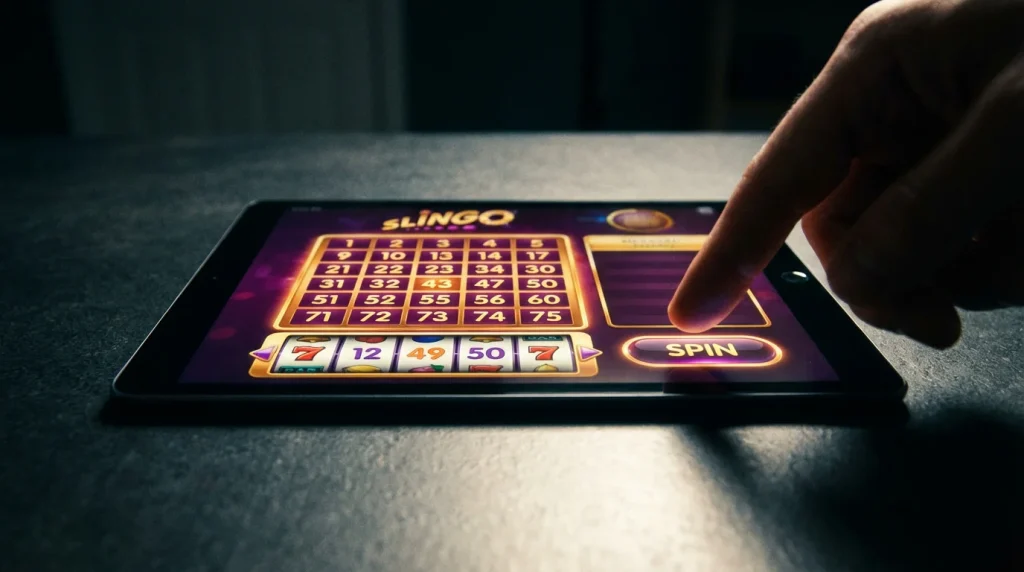
Every Slingo game starts with a 5×5 grid filled with numbers, laid out like a 75-ball bingo card. Below the grid sits a single row of five slot reels. When you spin, each reel produces a number (or a special symbol), and any number that matches a cell on your grid gets daubed automatically. The objective is to complete lines, patterns, or — in many titles — a full house, just as in bingo. The difference is that numbers are delivered by a slot mechanic rather than a ball caller, and each spin is a discrete event with its own outcome.
Most Slingo titles give you a fixed number of spins — typically 10 or 11 — included in the base stake. After those spins are used, you can purchase additional spins at an escalating cost. The price of each extra spin increases because the closer you get to completing the grid, the more valuable each remaining number becomes. This is where the slot-like decision emerges: is the potential prize from the next line or pattern worth the cost of the extra spin? The calculation changes with every purchase, and the game displays the cost before you commit, so the decision is informed rather than blind.
Special symbols appear on the reels alongside numbers. Wilds (often branded as Jokers) let you daub any cell in the corresponding column. Super Wilds let you daub any cell anywhere on the grid. Devils or blockers mark a reel position as empty, producing no number for that column on that spin. Free spin symbols add extra spins to your remaining total without additional cost. The interaction between these symbols and the grid state creates the game’s strategic texture — a Wild on the final spin of a game where you need one number to complete a line is a different proposition from a Wild on spin three of twenty.
Prize structures vary by title but generally follow a tiered model. Completing more lines or patterns moves you up a prize ladder displayed alongside the grid. The ladder might start at 0.2x your stake for one line and escalate to 100x or more for a full house. Some titles include bonus rounds triggered by completing specific patterns, which shift the game temporarily into a pure slot-style feature with multipliers, free spins, or pick-and-click mechanics. These bonus features are where the biggest payouts occur and where Slingo’s slot heritage is most visible.
The game resolves when all base spins and any purchased extra spins are exhausted. Your prize corresponds to the highest tier you reached on the ladder. Unlike bingo, there’s no competition with other players — Slingo is a solo game against the RNG, which means the prize is fixed by the paytable rather than pooled from ticket sales. This also means there’s no advantage to playing at specific times or in specific rooms. Your outcome is determined entirely by the spin results and the decisions you make with wildcards and extra spins.
Top Slingo Titles at Offshore Sites
The Slingo library at non-GamStop platforms is dominated by titles from two studios: Slingo Originals (now part of Gaming Realms) and a handful of third-party developers who license the format. Gaming Realms holds the trademark and produces the majority of official Slingo games, which means the core mechanics are consistent across titles — what changes is the theme, the bonus features, and the volatility profile.
Slingo Rainbow Riches remains one of the most widely stocked titles at offshore sites. It borrows the theme and bonus rounds from the Rainbow Riches slot franchise, layering Slingo grid mechanics over familiar features like Pots of Gold and Road to Riches. The combination of a recognisable brand with Slingo’s hybrid gameplay makes it a reliable draw. RTP sits at 95.6%, with medium volatility and a maximum win of up to 1,000x your stake.
Slingo Starburst adapts another major slot brand into the Slingo framework. The visual style mirrors NetEnt’s Starburst slot, but the mechanic is pure grid-and-reel Slingo. Wild symbols from the original slot are reinterpreted in Slingo Starburst as wilds that hold in place on the reel and trigger respins, giving players additional chances to match numbers on the grid. This adds a layer of interaction that the base slot doesn’t offer. It appeals to players who already know the Starburst aesthetic but want a game with more structure than a five-reel spin.
For players who prefer higher volatility, Slingo Extreme and Slingo XXXtreme push the format toward bigger swings. These titles increase the frequency of special symbols on the reels and raise the maximum prize multiplier, but they also increase the cost of extra spins more aggressively. The risk-reward profile is steeper: bigger potential payouts, but a higher likelihood of exhausting your spins without reaching a meaningful prize tier.
Beyond branded titles, the offshore market carries a range of themed Slingos — Deal or No Deal Slingo, Slingo Fluffy Favourites, Slingo Centurion — each inheriting the visual identity of an existing slot or game show brand. The mechanics across these titles are more similar than different. Once you understand how one Slingo game works, the learning curve for any other is minimal. The meaningful differences are in RTP, volatility, and bonus structure, which is where your selection should focus rather than on theme alone.
Slingo RTP and Volatility
Slingo RTPs cluster between 94% and 96%, which positions the format squarely alongside online slots and slightly above most bingo variants. The RTP represents the theoretical return over millions of spins — it’s a long-run average, not a session guarantee. A game with 95.6% RTP retains 4.4% of all money wagered over its lifetime, and individual sessions will deviate from that average in both directions.
What makes Slingo RTP less straightforward than slot RTP is the extra-spin mechanic. The published RTP for most Slingo titles assumes optimal play, meaning the player purchases extra spins only when the expected value of doing so exceeds the cost. In practice, most players don’t calculate expected value per spin — they buy extras based on gut feeling, proximity to a prize tier, or the momentum of a near-miss. Suboptimal extra-spin decisions reduce the effective RTP below the published figure, sometimes significantly. A game listed at 95% RTP can perform closer to 90% for a player who routinely buys extra spins when the maths doesn’t support it.
Volatility in Slingo works similarly to slots. Low-volatility titles produce frequent small wins — you’ll reach lower prize tiers regularly but rarely hit the top of the ladder. High-volatility titles produce longer dry stretches interrupted by occasional large payouts. Medium volatility, where most Slingo titles sit, balances the two. Your preference depends on your bankroll tolerance and session expectations: low volatility suits longer sessions with smaller budgets, high volatility suits players willing to accept more losing rounds for the chance of a bigger single hit.
One detail worth noting: the extra-spin pricing mechanism inherently increases the effective volatility of any Slingo game. When you purchase an extra spin at an elevated cost, you’re concentrating more money on fewer outcomes. A player who never buys extra spins experiences the game’s base volatility. A player who frequently buys extras — especially at the higher price tiers — is voluntarily increasing their variance, which amplifies both the potential reward and the potential loss per session. Understanding this interaction between extra-spin behaviour and volatility is the closest thing Slingo has to a strategic consideration.
Where Luck Meets Mechanics
Slingo’s appeal is that it feels like you’re doing something. Standard bingo is entirely passive once you buy your tickets — the numbers are called, the software daubs, and you either win or you don’t. Slots are one click per spin with no meaningful decision between rounds. Slingo inserts just enough player interaction — where to place a wild, whether to buy another spin — to create the sensation of agency within a game still governed by random number generation.
That sensation is genuine in the moment and irrelevant over time. The decisions you make with wilds and extra spins affect individual game outcomes, but they don’t shift the house edge. The RNG determines what appears on the reels; you determine what to do with wilds and whether to pay for more chances. Over thousands of games, the house edge holds regardless of your decisions. Over a single session, your choices can feel impactful — and that emotional engagement is what keeps the format alive in a market saturated with both bingo and slots.
At offshore sites, Slingo fills a specific niche. It’s the game you play when bingo feels too slow and slots feel too hollow. The hybrid structure gives each round a narrative arc — you start with a grid, watch patterns emerge, face decisions about extra spins, and arrive at an outcome that feels earned even when it was always determined by the RNG underneath. Whether that illusion of influence is worth the stake price is a personal calculation. The maths remains the same either way.