
Speed Bingo Not on GamStop
 Available in GB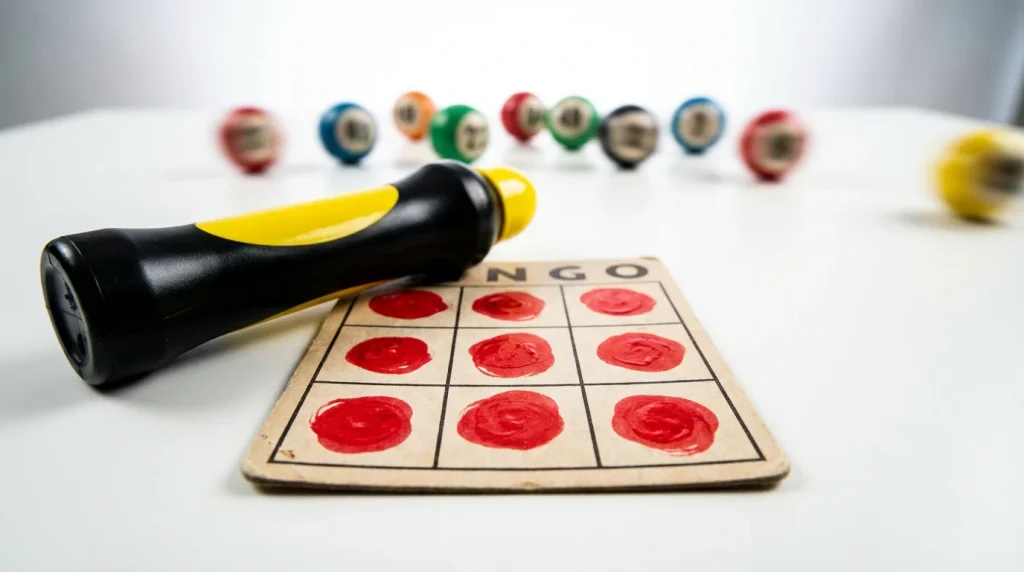
Bingo at Double Speed
Thirty-ball bingo strips the format to its minimum viable version. A 3×3 grid, nine numbers, one way to win: fill the entire card. No one-line consolation prizes, no two-line intermediate stage, no drawn-out progression through multiple tiers. The caller runs through 30 balls, and the first player to daub all nine cells takes the pot. A typical round finishes in under sixty seconds. At offshore sites not on GamStop, 30-ball rooms run continuously, often back-to-back with no pause between games, creating a pace that feels closer to slot play than traditional bingo.
The format exists because not every player has — or wants — a twenty-minute session per round. Speed bingo targets the segment that prefers quick resolution: players on a break, players splitting their session across multiple game types, or players who simply find the drawn-out cadence of 90-ball bingo more patience than they can sustain. The trade-off is simplicity. There’s no pattern variety, no strategic choice about which ticket to prioritise, and no social build-up through chat rooms (though chat is available, the rounds end too quickly for conversation to develop).
At non-GamStop platforms, 30-ball bingo fills the same niche as instant-win games and scratch cards — fast entertainment with minimal decision-making. The rooms are available around the clock at most sites that stock the format, and ticket prices tend to sit at the lower end of the range, reflecting the smaller prize pools that accompany shorter games.
Top online casinos in the UK
- ChanzeBonus: Slots Welcome Bonus #1 200% up to €500 · Payout speed: 1-3 business days
- BeOnBetBonus: 100% up to €500 + 100 FS · Payout speed: 1-3 business days
- x3betBonus: Welcome Pack 100% Up to £1.000 + 200 Free Spins · Payout speed: 1-3 business days
- JetsetspinsBonus: 200% Bonus + 100 Free Spins + Free Royal Wheel · Payout speed: 1-3 business days
- WinBeastBonus: €5000 + 500 FS + €650 Freebet · Payout speed: 1-3 business days
- NightWinBonus: £900 + 400 free spins · Payout speed: 1-3 business days
- Revery PlayBonus: 100% up to€1,000+ 100 FS · Payout speed: 1-3 business days
- EvoSpinBonus: 125% up to €2500 + 125 Free Spins · Payout speed: 1-3 business days
30-Ball Rules and Grid
The grid is as simple as bingo gets. Three rows, three columns, nine numbers — every cell contains a number, and every number needs to be daubed to win. There are no blank cells, no free spaces, and no partial-win tiers. The numbers are drawn from a pool of 30, with each column covering a specific range: column one typically holds numbers 1–10, column two covers 11–20, and column three covers 21–30. The exact range allocation can vary by software provider, but the principle is consistent.
Auto-daub handles all the marking, just as in other bingo formats. Given that the grid contains only nine numbers and the game resolves quickly, manual daubing would be impractical even for players who prefer it — the calls come too fast for human reaction time to keep pace, particularly when you’re holding multiple cards.
Most 30-ball rooms allow you to buy multiple cards per game. The typical range is one to six cards, though some rooms permit up to twelve. The more cards you hold, the higher your probability of being the first to complete a full house, because you’re covering a wider spread of numbers from the 30-ball pool. The probability mechanics are identical to other bingo variants: your win chance equals your cards divided by total cards in play.
Games end the moment a player completes their card. If two or more players complete on the same call, the prize splits. Because the pool is only 30 balls and each card contains nine numbers (30% of the total pool), full houses occur earlier in the draw sequence than in 75- or 90-ball games. Most 30-ball rounds resolve within 15 to 25 calls, though the exact number depends on how many cards are in play and how the drawn numbers align with the active grids. The compression of the draw into fewer balls and fewer cells is what creates the speed — less to draw, less to match, faster resolution.
Typical Prize Structures
Prize pools in 30-ball bingo are smaller than in 90-ball or 75-ball rooms, reflecting both the lower ticket prices and the shorter game duration. At offshore sites, ticket prices for 30-ball games typically range from 1p to 25p, with most rooms settling around 5p to 10p per card. The prize pool is generated from ticket sales minus the operator’s cut, just as in any other bingo format.
A typical 30-ball room with 50 players buying an average of four tickets each at 5p per ticket generates £10 in total sales. With a 20% operator margin, the prize pool is £8, paid to the winner of the full house. If two players complete on the same call, they split the £8. The numbers are modest, but the rounds are fast — a player can participate in 20 to 30 games per hour, and the cumulative prize exposure across those rounds is comparable to a slower format played over the same time period.
Some 30-ball rooms add a jackpot layer, typically a fixed prize for completing the full house within a very low number of calls — say, under 10. Given that nine specific numbers from a 30-ball pool all need to appear in the first 10 calls, the probability is extremely low, which allows the fixed jackpot to offer a disproportionately large payout relative to the ticket price. These jackpots serve the same function as progressive jackpots in 90-ball rooms: a background possibility that adds excitement without meaningfully altering the per-round economics.
The effective RTP in 30-ball bingo is comparable to other variants — typically 80% to 85% — because the operator’s margin is applied at the same rate regardless of game speed. The faster pace doesn’t improve your return; it simply compresses more rounds into less time, which means your bankroll depletes (or grows) at a faster rate per hour than in slower formats. Bankroll management matters more in speed bingo precisely because the tempo leaves less time for reflection between ticket purchases.
When Speed Bingo Works Best
Thirty-ball bingo is at its best as a supplement, not a staple. It works well as a warm-up before a 90-ball session, as a change of pace between longer games, or as a quick-play option when you have ten minutes rather than an hour. The format doesn’t sustain extended sessions as effectively as 90-ball or 75-ball, because the absence of intermediate prize tiers means every round is binary — you either win or you don’t — and that all-or-nothing cycle becomes monotonous faster than the multi-tier progression of longer formats.
The format also suits players who prefer to manage their bankroll in small, discrete increments. Each 30-ball round is a micro-session: buy tickets, watch the draw, see the result, decide whether to play again. There’s no commitment to a longer game cycle, no sunk cost in tickets already purchased for a round that hasn’t resolved. If you decide to stop after five rounds, you’ve spent 30 seconds to a minute per round and whatever those tickets cost. The exit is immediate.
Where speed bingo works less well is for players who value the social and communal aspects of bingo. The chat rooms in 30-ball games are typically quieter than in 90-ball rooms, because the game pace doesn’t allow for sustained conversation. The community element that defines bingo as a social activity rather than a solitary game is diminished in speed formats. If the chat experience matters to you, 30-ball is the wrong room.
Off-peak hours offer better value in 30-ball rooms, just as they do in any bingo format. Fewer players means fewer competing tickets and better per-card probability. The effect is amplified in 30-ball because the small card size and compressed draw sequence mean that each additional competitor has a proportionally larger impact on your individual odds than in a 90-ball room with hundreds of tickets in play.
Under a Minute
Speed bingo does what it says on the tin. The round starts, the numbers fall, someone wins, the next round loads. There’s a purity to that cycle — no anticipation building across a five-minute draw, no escalating tension through one-line and two-lines, just a direct path from ticket purchase to outcome. Whether that directness appeals to you depends on what you’re looking for from a bingo session.
At offshore sites, 30-ball rooms are a permanent fixture rather than a novelty. They fill the gap between bingo’s social, slow-paced heritage and the instant-gratification model of slots and scratch cards. The game is genuinely bingo — random draw, grid matching, pooled prizes — but compressed into a format that fits the attention span of a notification rather than a conversation. Use it accordingly. Set a round limit before you start, because at one game per minute, fifty rounds pass faster than you think.